
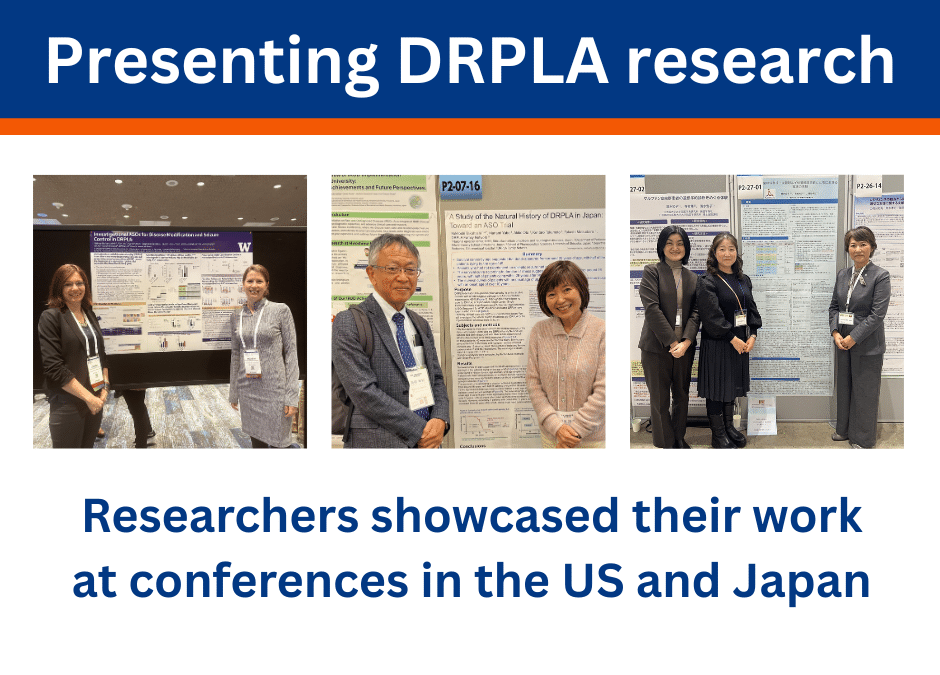
Updates from conferences in the United States
Prof Melissa Barker-Haliski and Dr Joanna Korecka-Roet, together with their teams and collaborators, who presented a poster entitled “Investigational ASOs for Disease Modification and Seizure Control in DRPLA” at the American Epilepsy Society (AES) meeting in December.
With a grant from AES, they worked with a DRPLA mouse model and showed how early intervention with an antisense oligonucleotide reduced the number of seizures and improved the ataxia symptoms. Their research builds on earlier work and looks more closely at the epilepsy symptoms seen in these mice, which we first reported here.
This group of scientists is presenting further updates to their work at another conference, the 2026 American Society for Pharmacology and Experimental Therapeutics in May.
Updates from conferences in Japan
Junko Shiozawa, Advisory Board Member for CureDRPLA, has played a key role in building a community of Japanese individuals with DRPLA and their families. To formalize her work and expand the impact of such initiatives in Japan, Junko has created the DRPLA Family Network (DFN). CureDRPLA and DFN have strong ties, continue to work together, and will collaborate as needed to fulfill our missions. DFN is off to a great start and is already collaborating with researchers and clinicians based in Japan.
70th Annual Meeting of the Japanese Society of Human Genetics
A poster entitled “A Study of the Natural History of DRPLA in Japan” was presented by Prof Yukitoshi Takahashi, his collaborators and the DRPLA Family Network. In this poster, they looked at the progression of symptoms in 43 people with DRPLA.
A second poster was presented at this conference entitled “DRPLA in Japan: real-world data based on J-CAT” by Prof Yuji Takahashi, Prof Hidetoshi Date, Prof Yuka Hama and Prof Hidehiro Mizusawa. The Japanese Ataxia Consortium (J-CAT) is a nationwide online registry for all types of ataxia. Among the 3,474 people enrolled in J-CAT in May 2025, 82 were diagnosed with DRPLA. Such registries allow clinicians to better characterise DRPLA and identify participants for future studies, including clinical trials.
45th Annual Meeting of the Japanese Society of Nursing Science
Prof Ryoko Okui, Prof Yuko Nagashima and Prof Yukie Takada from Komazawa Women’s University presented a posted entitled “Experiences of Families Living with DRPLA”.
From speaking with families affected by DRPLA, the clinicians were deeply moved by the severity of their experiences and the strength they show in continually rebuilding their lives. Even in the face of uncertainty, many shared that the N-of-1 trials brought a small but meaningful sense of hope. Several also expressed that, while progress may not come in time for their own loved ones, they find purpose in helping future generations and in raising awareness to reduce the stigma surrounding genetic conditions.