
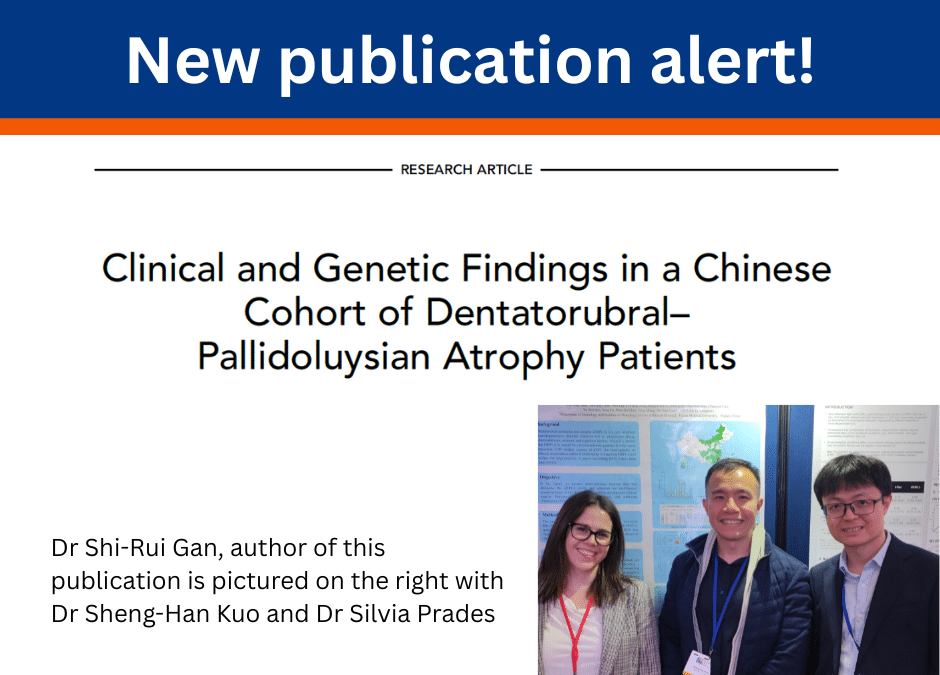
The most comprehensive description of symptoms and findings from clinical tests, brain scans, and blood tests from people living with DRPLA has been published by Dr Shi-Rui Gan and his collaborators based in China.
They enrolled 116 people living with DRPLA across China:
- 96 had symptoms (called “manifest”), of which 73 presented with adult-onset DRPLA (age of symptom onset >20 years) and 23 with juvenile-onset DRPLA (age of onset ≤20 years).
- 20 people has been diagnosed but had no major symptoms yet (called “prodromal”).
Study participants ranged from 2 to 71 years old and with 49 to 83 CAG repeats.
Adults usually first noticed balance problems or clumsiness (84% started with walking difficulties). Many also had involuntary movements and trouble thinking clearly. Children and teenagers often first had seizures and developmental delays. Almost all patients developed ataxia (problems with balance and coordination) as the disease progressed.
Analysis of brain scans revealed that in the early-stage (prodromal), the damage was limited to the cerebellum, which is the part of the brain that controls balance. In those with more clear symptoms (manifest), the damage was more widespread, including deeper brain regions. These changes help explain both movement and cognitive symptoms.
The team measured a protein in blood called neurofilament light (NfL), which increases when brain cells are damaged. NfL levels were much higher in people with DRPLA who had symptoms than in those without symptoms or in people without DRPLA (controls). More research is needed to confirm this, but perhaps NfL could be used as a blood marker to monitor progression.
The researchers found a unique genetic fingerprint (a set of 8 small DNA variations) that was the same in all the Chinese families with DRPLA. This suggests a shared ancestral origin of DRPLA within China.
This study is cross-sectional, meaning that the data were collected at a single point in time. While this approach helps clinicians better characterize DRPLA and understand how it presents in different individuals, it does not provide insights into how symptoms change or progress over time. To capture that progression, researchers need to collect clinical data and biosamples repeatedly as part of a longitudinal study like in the DRPLA Natural History and Biomarkers Study. Much like taking a video on the same day each year to see how things evolve and differ over time.
To read the full scientific article by Dr Gan, visit this page.